
News & Stories
2025
News
HKUST Partners with France on Pioneering Sustainability Research Exchange
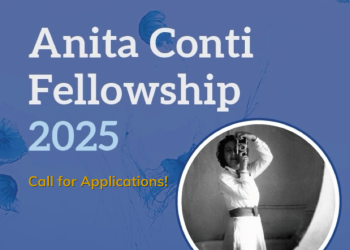
The Hong Kong University of Science and Technology (HKUST) is proud to be the exclusive university partner of the Consulate General of France in Hong Kong & Macau for the Anita Conti Sustainable Innovation Fellowship, under the partnership framework of France-HKUST Innovation Hub.
The Fellowship pays tribute to Anita Conti (1899-1997), also known as « la Dame de la Mer » (the Lady of the Sea ) and the first French woman oceanographer and a pioneer in marine ecology, as well as her scientific contribution and commitment to the protection of the oceans. It aims to inspire the next generations of researchers, innovators, and environmentalists to address the challenges of climate change and its impacts on our planet.
2023
News
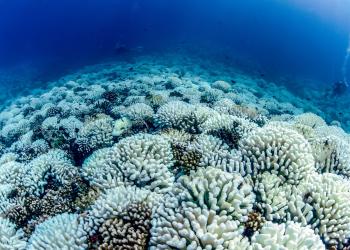
Fathoming the Hidden Heatwaves that Threaten Coral Reefs
In April to May 2019, the coral reefs near the French Polynesian island of Moorea in the central South Pacific Ocean suffered severe and prolonged thermal bleaching. The catastrophe occurred despite the absence of El Niño conditions that year, intriguing ocean scientists around the world.
2021
News
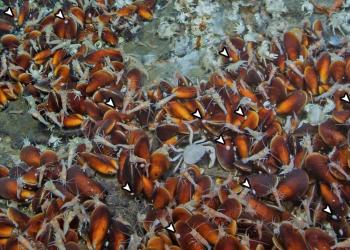
Research jointly led by HKUST and HKBU Unlock Biogeographical Secrets of Deep-sea Limpets
Researchers from The Hong Kong University of Science and Technology (HKUST) and Hong Kong Baptist University (HKBU) have decoded for the first time the demographic history, genetic structure, and population connectivity of a deep-sea limpet widely distributed in vent and seep ecosystems in the Northwest Pacific. This study not only enhances our knowledge of the historical population divergence and contemporary gene flow of deep-sea organisms under the intricate interactions amongst local habitats, seafloor topography, and ocean currents, but also serves as a scientific basis for better conservation of marine biodiversity and more effective environmental management.
News
HKUST Research Shows Growing Dominance of Diatom Algae in the Pearl River Estuary
It is a common perception that waters close to population would be more polluted than those offshore or at higher latitudes. However, researchers from The Hong Kong University of Science and Technology (HKUST) found that the ratio between two common microalgae diatom and dinoflagellate (dino) – a common benchmark of water quality, has been nearly doubled in the Pearl River Estuary (PRE), one of the world’s most urbanized subtropical coastal waters, over the past two decades.
News
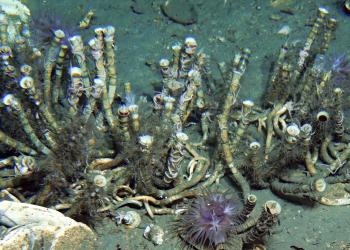
HKUST Researchers Unlock Genomic Secrets of Gutless Deep-sea Tubeworm
Researchers from The Hong Kong University of Science and Technology (HKUST) decoded for the first time the chromosomal-level genome of a deep-sea gutless tubeworm and how the worm’s co-living bacterial partners manufacture organic nutrients for its host so it can survive the extreme habitat. The discovery lays foundation for potential applications such as biomaterial production and microbial growth control.Living in deep-sea hydrothermal vents and cold seeps ecosystems characterized by darkness, high pressure and often high concentrations of toxic substances, submarine tubeworms - common living organisms of such extreme environments, were known to owe their survival and fast growth to sulphide-oxidising symbiotic bacteria that live inside their body. However, the success behind such a complementary “marriage” between the tubeworms and their co-living bacteria had remained unknown due to the lack of genomic resources.
News
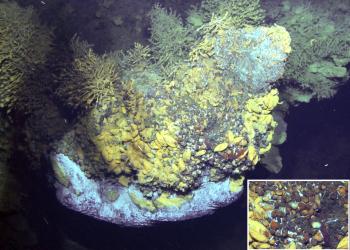
HKUST decodes a deep-sea vent-endemic snail hologenome and unveils its living strategies in the extreme environment
A research team led by Prof. QIAN Peiyuan, Head and Chair Professor from the Hong Kong University of Science and Technology (HKUST)’s Department of Ocean Science and David von Hansemann Professor of Science, has published their cutting-edge findings of symbiotic mechanisms of a deep-sea vent snail (Gigantopelta aegis) in the scientific journal Nature Communications. They discovered that Gigantopelta snail houses both sulfur-oxidizing bacteria and methane-oxidizing bacteria inside its esophageal gland cells (part of digestive system) as endosymbionts. By decoding the genomes of both snail host and two symbionts, Prof. Qian’s team disclosed a novel dual symbiosis system and the molecular adaptation to the extreme environment, gaining a new understanding of the origin of life on Earth.