






News & Stories
2026
News
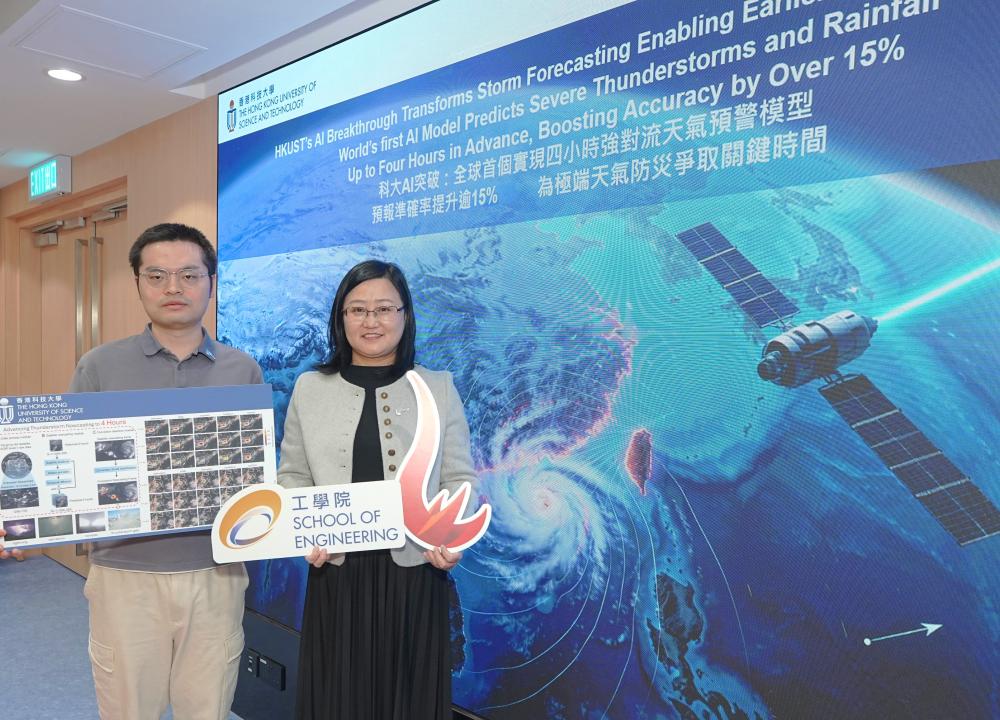
HKUST's AI Breakthrough Transforms Storm Forecasting Enabling Earlier Life-Saving Warnings
In a critical advance for climate resilience, researchers from The Hong Kong University of Science and Technology (HKUST) have developed an AI model that can predict dangerous convective storms—including Black Rainstorms, thunderstorms and extreme heavy rainfall like those that have hit Hong Kong—up to four hours before they strike. This world-first technology, developed in collaboration with national meteorological institutions and powered by satellite data and advanced deep diffusion technology, improves forecast accuracy by over 15% at the 48‑kilometer spatial scale compared with existing systems. This breakthrough strengthens the overall accuracy of the national weather forecasting system and promises to transform early warning systems for vulnerable communities across Asia.
News
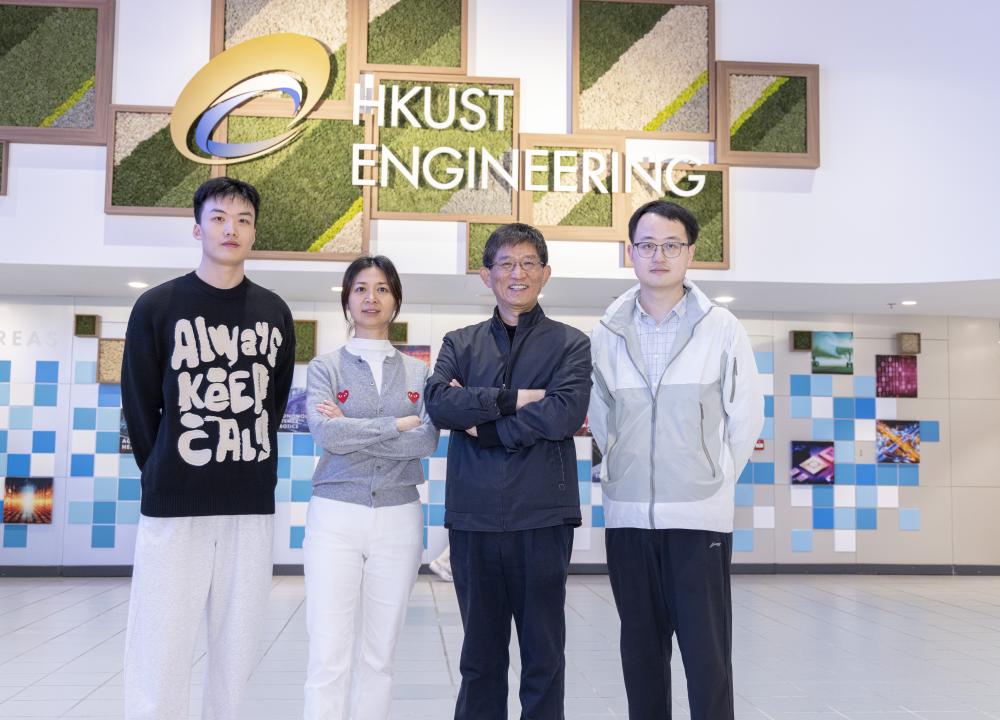
HKUST Develops World’s First Sub-Zero Celsius Elastocaloric Green Freezer, Reshaping Freezing Industry with its Zero Emissions
Researchers at the School of Engineering of The Hong Kong University of Science and Technology (HKUST) have developed the world’s first Sub-Zero Celsius elastocaloric freezing device, capable of reaching temperatures as low as -12℃. This represents a significant milestone in expanding green solid-state elastocaloric refrigeration technology into the global freezing industry, offering a promising solution to combat climate change and accelerate low-carbon transformation of the global freezing market. The findings have recently been published in the international journal Nature, under the title “Sub-zero Celsius Elastocaloric Cooling via Low-transition-temperature Alloys”.
2025
News
HKUST Researchers Unlock Why Arctic Ice Melt Paused
A research team led by The Hong Kong University of Science and Technology (HKUST) scholars has discovered a significant slowdown in Arctic sea ice melting since 2012, with the decrease rate of 11.3% per decade to an insignificant downward trend of only −0.4% per decade. This phenomenon is closely related to a shift in the North Atlantic Oscillation (NAO) pattern, from a negative phase to its positive phase, which traps cold air within the Arctic region. It is projected to peak between 2030 and 2040, after which the Arctic could enter a new phase of accelerated ice melt. Without reductions in greenhouse gas emissions, this may trigger severe climate and environmental crises within decades.
News
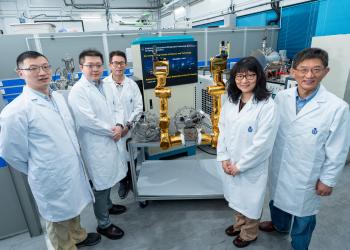
HKUST Leads International "Hong Kong Operation Robot" Project
The Hong Kong University of Science and Technology (HKUST) has been appointed by the China National Space Administration (CNSA) to lead the international "Hong Kong Operation Robot" project for the Chang'E-8 mission. The project will unite global aerospace scholars and experts to develop a multi-functional lunar surface operation robot. Equipped with a mobile charging station and capable of dexterous operations, the robot is designed to make significant contributions to the nation's lunar exploration missions.

News
HKUST and Towngas Jointly Establish Hong Kong’s First Hydrogen Energy Industry Innovation Platform
The Hong Kong University of Science and Technology (HKUST) and The Hong Kong and China Gas Company Limited (Towngas) today signed a Memorandum of Understanding on Strategic Cooperation to establish Hong Kong’s first hydrogen energy innovation platform. Leveraging global academic and industry expertise, the two parties will collaborate on areas such as technology commercialisation and related fields. This partnership aims to accelerate the development and broader application of hydrogen energy technologies, injecting fresh momentum into the nation’s dual-carbon strategy and the global transition to a low-carbon future.
News
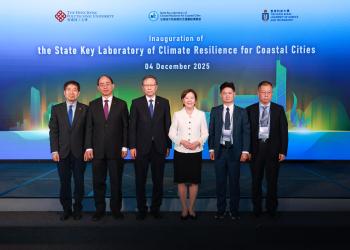
HKUST and PolyU Inaugurate State Key Laboratory of Climate Resilience for Coastal Cities
Approved by the Ministry of Science and Technology (MOST) of the People’s Republic of China, the State Key Laboratory of Climate Resilience for Coastal Cities (SKL-CRCC) – jointly established by The Hong Kong University of Science and Technology (HKUST) and The Hong Kong Polytechnic University (PolyU) – was officially inaugurated today. Dedicated to addressing the challenges posed by climate change, the Laboratory aims to enhance infrastructure resilience in Hong Kong, the Chinese Mainland and coastal cities worldwide. Its core missions include strengthening climate-risk early-warning systems and emergency response capabilities, and promoting sustainable development to address challenges posed by climate change. Concurrently, a two-day international symposium is being held, bringing together world-leading experts and scholars to discuss how climate resilience in coastal cities can be strengthened globally.
News
HKUST Unites International Experts in CliMetS Initiative to Tackle Climate Threat of Seabed Methane Seeps
The Hong Kong University of Science and Technology (HKUST) has successfully launched the Global Climate Impact of Methane Seeps (CliMetS) Initiative through a pivotal collaboration with the Southern Marine Science and Engineering Guangdong Laboratory (Guangzhou) (GML) and over 200 experts worldwide. Endorsed as a UN Ocean Decade Action, CliMetS is dedicated to mapping seabed methane seeps across the world’s oceans and quantifying their impact on global climate systems. Recently, HKUST co-led two milestone workshops in South America and Africa, galvanizing global efforts to address methane seep research gaps and fostering cross-continental partnerships.
News
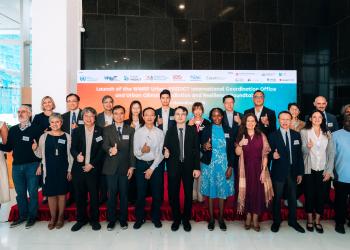
HKUST Launches UN-Backed International Coordination Office for Urban Climate Resilience
The Hong Kong University of Science and Technology (HKUST) today officially launched the International Coordination Office for Urban-PREDICT, a flagship initiative of the United Nations' World Meteorological Organization (WMO), cementing its position as a global leader in urban climate science. The inauguration ceremony, attended by prominent international scientists, policymakers, and industry experts, was followed by the Urban Climate Prediction and Resilience Roundtable, marking a momentous step in global efforts to address urban climate risks through cutting-edge science and cross-sector collaboration.